
Adaptogens have moved from Ayurvedic and traditional Chinese medicine into mainstream clinical conversation faster than the evidence has caught up. A patient walks in already taking ashwagandha gummies, a wellness influencer is selling rhodiola for “burnout,” and a practitioner is left to triangulate what is actually known about these plants and what is wishful thinking. This piece is for that practitioner — an honest read on where the adaptogen evidence is strongest, where it is weakest, and how to integrate the well-supported ones into a clinical plan without overselling.
What “adaptogen” actually means
The term has a precise origin and a much looser modern usage. Coined by Soviet pharmacologist Nikolai Lazarev in the 1940s, an adaptogen was defined as a substance that (a) increases nonspecific resistance to stressors, (b) has a normalising influence on physiology regardless of direction of imbalance, and (c) is broadly nontoxic at therapeutic doses. Modern research has largely validated the framework: true adaptogens act on the hypothalamic-pituitary-adrenal (HPA) axis, modulate cortisol response, and influence stress-related neurotransmitters.
The marketing usage has expanded far beyond plants that meet those criteria. Mushrooms, herbs, and even some vitamins now carry the label. For clinical purposes, it helps to stay close to the original definition and apply healthy scepticism to the rest.
Ashwagandha (Withania somnifera) — the most clinically validated
Of all the adaptogens, ashwagandha has the deepest randomised controlled trial record. Multiple meta-analyses converge on consistent findings: it measurably reduces perceived stress and cortisol, improves sleep quality, and modestly improves strength and recovery in resistance-trained individuals. Effective doses sit between 300–600 mg/day of a standardised root extract (typically KSM-66 or Sensoril, both well-characterised in the literature).
Clinical use cases where it earns its keep: chronic stress with elevated evening cortisol, sleep onset difficulty tied to “tired but wired,” subclinical hypothyroidism (it appears to raise T4 modestly, which is sometimes wanted and sometimes not), and male hypogonadism with stress as a co-factor. Cautions: it can raise thyroid hormone levels enough to matter in hyperthyroid patients, and pregnancy is a clear contraindication.
The traditional Ayurvedic context
It is worth noting that ashwagandha is not a “new” supplement; it is one of the most-used rasayana herbs in classical Ayurvedic practice, traditionally given as a milk decoction at bedtime. Modern dosing has translated that into capsules and powders, but the traditional vehicle — taken with warm milk and honey — was based on absorption considerations that hold up surprisingly well to modern pharmacokinetic understanding (the lipid carrier improves bioavailability of the withanolides).
Rhodiola (Rhodiola rosea) — the focus-and-fatigue adaptogen
Rhodiola’s evidence base is smaller than ashwagandha’s but consistent. Standardised extracts (typically containing 3% rosavins and 1% salidroside) show reproducible benefits for mental fatigue, cognitive performance under stress, and mild-to-moderate depressive symptoms — particularly the “burnt out, drained, cannot focus” presentation rather than classical major depression. Typical dose: 200–400 mg/day of a standardised extract, taken in the morning (it can disrupt sleep if taken late).
Where it does not belong: as a primary intervention for clinical depression, anxiety disorders requiring formal treatment, or as a substitute for addressing the underlying stress load. As a clinical adjunct for high-functioning patients in a draining season, it has earned its place.
Tulsi, Reishi, and the rest
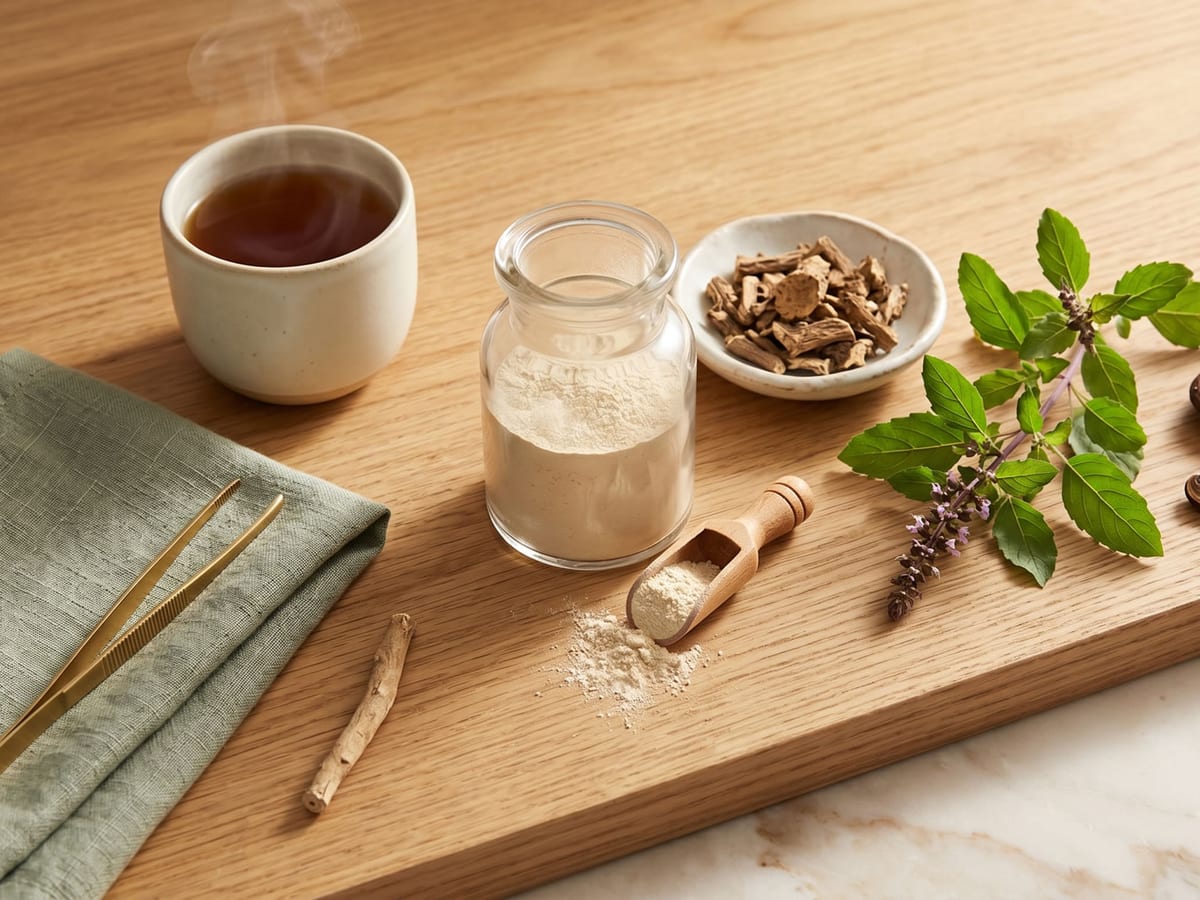
Tulsi (Ocimum sanctum) sits in a respectable middle of the evidence base — good support for stress modulation, blood glucose regulation, and immune function at doses around 500 mg/day of leaf extract. It is also the most accessible of the lot in India — daily tulsi tea is a low-effort intervention with low downside.
Reishi (Ganoderma lucidum) has cleaner evidence for immune modulation and sleep support than for the broader “adaptogen” claims often made for it. Used at 1.5–3 g/day of standardised extract over 8–12 weeks, it appears to genuinely modulate certain immune markers and improve sleep architecture. Its bitter taste is its main adherence challenge.
Other commonly marketed adaptogens — schisandra, cordyceps, holy basil, eleuthero, ginseng varieties — vary widely in evidence quality. None are dangerous at sensible doses; few have the kind of replicated clinical trial support that ashwagandha and rhodiola enjoy.
How to integrate adaptogens into a clinical plan
Three principles keep adaptogen use grounded in clinical reality. First: address the load before the adaptation. An adaptogen is not a substitute for fixing sleep, nutrition, or chronic over-commitment. A patient whose stress load is genuinely unmanageable will not be rescued by ashwagandha; they need the load reduced. Second: match the adaptogen to the picture. Ashwagandha for cortisol-dominant, anxious-tired patterns. Rhodiola for cognitively drained, low-energy mornings. Tulsi for general daily resilience. Reishi when sleep and immune modulation are the priority. Third: respect the timing. Adaptogens are subtle. Most show their effect at 4–8 weeks, not 4–8 days. Patients expecting immediate change disengage; those briefed to give it two months tend to stay the course and notice meaningful change.
Quality also matters more here than in most supplement categories. Adulteration is well-documented for ashwagandha in particular; sourcing from a manufacturer with third-party identity verification and standardised extract analysis is non-negotiable for clinical use. When we manufacture adaptogenic blends for partner brands under our contract manufacturing programme, identity testing, withanolide assay, heavy-metal panels, and stability data accompany every batch — because the alternative is recommending a product whose actual content you cannot verify.
Adaptogens deserve neither the hype they currently attract nor the dismissal of an earlier generation of clinicians. Used selectively, on the right patient, at the right dose, with the right preparation, the well-studied ones earn their place in a thoughtful clinical plan. The work is in resisting the marketing pressure to recommend them for everything, and in keeping the focus on root-cause work alongside any supplementation. The Horta practitioner network shares clinical case notes on adaptogen protocols quarterly — if you are using these herbs in practice and want a peer view on what is working in other clinics, that is the place.